



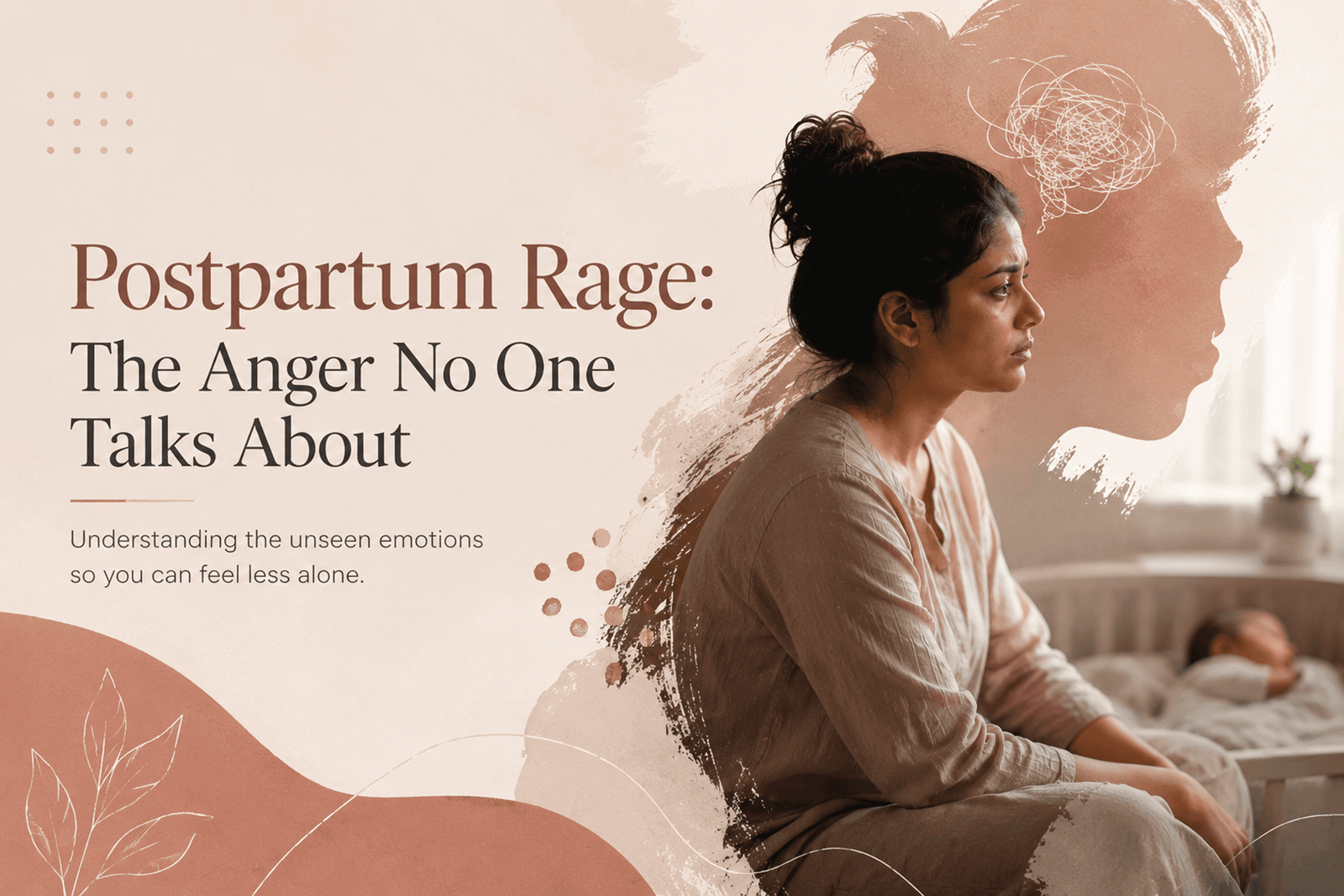
Postpartum rage is real and more common than you think. Learn the signs, causes, and how Maaanaya helps Indian mothers heal from postpartum anger
Postpartum Rage: The Anger No One Talks About
Postpartum depression affects an estimated 1 in 7 mothers worldwide, and anger or rage is one of its most overlooked symptoms — one many women never mention to their doctor because they don’t recognise it as a medical issue at all. You were ready for the tears. Every article, every aunty, every well-meaning WhatsApp forward warned you about the crying spells that come with new motherhood. Nobody warned you about this — the sudden, scalding urge to scream at your partner for loading the dishwasher wrong, the fury at a crying baby who simply won’t settle, the shame that follows five seconds later.
This is postpartum rage, and it is one of the least discussed, most misunderstood parts of the fourth trimester. If you’ve felt a flash of anger so intense it frightened you, you are not a bad mother, and you are not alone. This guide breaks down what postpartum rage actually is, why it happens, and — most importantly — what genuinely helps.
Key Takeaways
- Postpartum rage is sudden, intense anger or irritability after childbirth — usually a symptom of postpartum depression or anxiety, not a standalone diagnosis.
- Hormonal shifts, sleep deprivation, invisible mental load, and cultural pressure to “stay calm and grateful” are the biggest drivers, especially for Indian mothers.
- It’s treatable. Screening, therapy, redistributing household load, and ruling out thyroid issues all measurably help.
- Seek urgent help if the anger involves physical outbursts, frightening intrusive thoughts, or any fear of harming yourself or your baby.

What Is Postpartum Rage?
Postpartum rage refers to sudden, intense episodes of anger or irritability that appear after childbirth — often disproportionate to whatever triggered them. It isn’t a standalone diagnosis in clinical manuals. Instead, it’s usually a symptom that shows up inside other postpartum mood conditions, most commonly postpartum depression and postpartum anxiety.
That distinction matters. Many new mothers assume that because they aren’t crying constantly or feeling “sad,” they can’t have postpartum depression. But anger is one of the most under-recognised faces of it — clinical reviewers now describe intense postpartum anger as a symptom that gets missed precisely because standard screening questionnaires rarely ask about it directly.
How Postpartum Rage Differs from Normal New-Mom Frustration
Every new parent gets frustrated. Postpartum rage is different in intensity and aftermath. Ordinary frustration passes; postpartum rage often arrives as a full-body surge — clenched jaw, racing heart, the urge to hit a wall or throw something — followed by guilt and fear that can linger for hours.
Postpartum Rage vs. Postpartum Depression vs. Postpartum Anxiety
- Postpartum depression (PPD) typically centres on low mood, numbness, hopelessness, or loss of interest — though irritability and anger are recognised symptoms too, especially in mothers who don’t fit the “sad and crying” stereotype.
- Postpartum anxiety (PPA) centres on excessive worry, racing thoughts, and a constant sense of dread — anger often shows up as the nervous system’s fight response getting stuck in the “on” position.
- Postpartum rage can occur inside either condition, or on its own, as a distinct symptom cluster of anger and irritability.
If you’re unsure which pattern fits you, our guide on postpartum anxiety signs and causes and our breakdown of baby blues versus postpartum depression can help you tell the difference. If your anger traces back to a difficult delivery, it’s also worth reading our piece on birth trauma and postpartum PTSD.
Postpartum Rage vs. Normal Frustration: A Quick Comparison
| Aspect | Normal New-Mom Frustration | Postpartum Rage |
|---|---|---|
| Trigger | Proportionate to the situation (a hard night, a fussy feed) | Often disproportionate — a small thing sets off a big reaction |
| Physical sensation | Mild tension, sighing, tiredness | Hot face, clenched fists, racing heart, tight chest |
| Duration | Passes within minutes | Can feel like it takes over completely, even briefly |
| Urges | Wanting a break or some quiet | Intrusive urges to yell, throw something, or hit a wall |
| Aftermath | Mild irritation, forgotten quickly | Intense guilt, shame, or fear that lingers for hours |
| Frequency | Occasional, tied to specific bad days | Frequent, unpredictable, or worsening over weeks |
| What it usually needs | Rest, a support system, patience | Screening, professional support, and often treatment for an underlying condition |
If your experience consistently sits in the right-hand column, it’s worth getting screened rather than waiting for it to pass on its own.
Signs and Symptoms of Postpartum Rage
Postpartum rage doesn’t look the same for every mother, but common signs include:
- Sudden anger that feels “out of proportion” to the trigger
- A short fuse with your partner, older children, or even the baby
- Physical sensations — a hot face, clenched fists, racing heart, tight chest
- Intrusive urges to yell, throw something, or hit a wall (without acting on them)
- Intense guilt or shame immediately after an outburst
- Feeling constantly “on edge,” like your patience is permanently running on empty
- Snapping at small, everyday things — a dropped spoon, a slow WiFi connection, unsolicited advice from a relative
Quick Self-Check: Am I Experiencing Postpartum Rage?
Ask yourself how many of these have been true in the last two weeks:
- I’ve felt anger that scared me with how intense it was
- I’ve snapped at my baby, partner, or family more than I’d like to admit
- I feel guilty or ashamed after most outbursts
- I feel “on edge” most of the day, not just occasionally
- I’ve had urges to throw or hit something (without acting on it)
- Family members have commented on my mood or temper
Checked 3 or more? It’s worth taking a proper screening rather than waiting to see if it passes — start Maaanaya’s free mental health screening here.
Experiencing one or two of these occasionally, especially in the sleep-deprived newborn weeks, doesn’t automatically mean something is wrong. What matters is frequency, intensity, and whether the anger is starting to scare you or affect your relationships.

Why Does Postpartum Rage Happen?
Postpartum rage is rarely about one single cause. It’s usually several stressors converging at once.
Hormonal Shifts After Childbirth
In the days after delivery, estrogen and progesterone — hormones that helped regulate mood throughout pregnancy — drop sharply. This hormonal cliff, combined with fluctuating cortisol and disrupted sleep cycles, can leave the nervous system unusually reactive. For many women, anger becomes the emotion that surfaces first, before sadness ever does.
Sleep Deprivation and Physical Exhaustion
Chronic sleep deprivation lowers the threshold for irritability in anyone. Layer that onto a body still healing from birth, and the margin for patience shrinks fast. Even minor frustrations can feel unbearable when you’re running on two-hour sleep stretches.
The Mental Load and Invisible Labour
Tracking feeds, naps, vaccination schedules, paediatrician appointments, and household logistics — often while also managing a household’s expectations — creates a background hum of stress that rarely gets acknowledged. When that invisible labour goes unseen or unshared, resentment builds quietly until it erupts.
Cultural Expectations Around Indian Motherhood
In many Indian households, mothers are expected to absorb stress silently, prioritise the baby’s needs above their own, and appear grateful and composed regardless of how depleted they feel. A few patterns specific to Indian family life tend to intensify postpartum rage:
- Joint family dynamics. Living with in-laws during the postpartum period can mean constant, well-meaning but unsolicited advice about feeding, sleep, or the baby’s routine — leaving little room for a mother’s own instincts or boundaries.
- The confinement period (“jaappa” or “sutika kaal”). Traditional postpartum rest periods are meant to protect a mother’s recovery, but when they come with rigid rules enforced by relatives rather than genuine support, they can feel more controlling than caring.
- Return-to-work pressure. With short or unpaid maternity leave in many workplaces, mothers often feel forced to “perform normal” at the office while still physically and emotionally depleted at home — a dynamic covered in more depth in our piece on whether working mothers are more stressed.
Anger is often treated as an emotion Indian mothers “shouldn’t” have — which doesn’t make the anger disappear. It usually means it goes underground, directed inward as guilt or self-criticism instead of being expressed and addressed.
Underlying Conditions
Postpartum rage can also be linked to postpartum depression, postpartum anxiety, postpartum OCD, or an undiagnosed thyroid imbalance (common after delivery). Nutritional depletion after birth can compound this too — see our guide on nutrition and postpartum recovery for what to prioritise. This is why a proper assessment — not guesswork — matters.
If postpartum rage is affecting how you’re showing up for your family, don’t wait it out. Book a session with our care team — you don’t need a crisis to justify asking for support.
What the Research Says
Maternal mental health remains under-researched in India, but the data that does exist points to a significant, often invisible burden. A 2025 scoping review of postpartum depression research in India found that reported prevalence rates swing widely — from around 4% to nearly half of mothers studied — depending on the hospital, region, and screening tool used, with a traumatic birth experience and cesarean delivery consistently linked to higher risk.
The same review noted how thin the evidence base still is: most available research comes from small, hospital-based samples, leaving large gaps in what’s actually known about postpartum mental health across the country. That gap means many mothers experiencing anger and irritability after birth are never formally screened, let alone treated — which is part of why standardised, LaQshya-aligned maternal care protocols and routine mental health screening at every postpartum visit matter so much.
Internationally, the picture is similar. ACOG’s guidance on postpartum depression notes that anger toward a baby, partner, or other children is a recognised feature of the emotional shifts that follow childbirth, alongside sadness and anxiety, and that these feelings can persist well beyond the initial “baby blues” window if left unaddressed. A separate cross-sectional study on postpartum anger found that mothers’ anger has historically been neglected by researchers relative to depression and anxiety, despite evidence linking persistent anger to poorer sleep, higher fatigue, and a heavier share of infant-care responsibilities.
Clinical writing on postpartum rage also frames it as a stress signal rather than a personality flaw — a sign that a mother’s coping resources are overwhelmed, not that something is fundamentally wrong with her.
Why No One Talks About It
Motherhood is culturally scripted as tender, patient, and endlessly giving — especially in India, where a mother’s self-sacrifice is often treated as the measure of her love. Anger doesn’t fit that script, so it gets hidden.
Many mothers stay silent because they fear being judged as “unfit,” worry a relative will use it against them, or simply don’t have the vocabulary to describe what they’re feeling as anything other than “I’m a bad mom.” The result is a cycle: rage builds in silence, guilt follows, and the isolation makes the next episode more likely — not less.
Naming it changes that. Postpartum rage has a name, a known set of causes, and real treatment pathways — much like the emotional shifts covered in our piece on the transition from woman to mother, or the cultural guilt explored in Mother’s Day vs. Everyday.
What Postpartum Rage Actually Feels Like
To make this less abstract, here’s what postpartum rage commonly looks like in everyday moments (composite scenarios drawn from common patterns mothers describe, not individual case details):
- A mother finds herself screaming into a pillow after her baby’s third wake-up of the night, terrified by how loud the sound in her head had become.
- A new mother snaps at her mother-in-law over an offhand comment about her parenting during the confinement period, then spends the rest of the day replaying it with shame.
- A working mother feels a flash of fury at her partner for “helping” without being asked, exhausted by constantly having to direct every task herself while also managing pressure to return to office early.
- A mother in a joint family setup feels rage build every time a relative walks in unannounced to “check on the baby,” because it means one more performance of composure she doesn’t have the energy for.
None of these moments make someone a dangerous or unfit parent. They’re signals — the nervous system’s way of flagging that support, rest, or professional help is overdue.

When to Seek Help for Postpartum Rage
Reach out to a mental health professional or your obstetrician if:
- The anger is constant, not occasional
- You’ve hit a wall, thrown something, or feared losing control around your baby
- You feel disconnected from yourself or your baby for extended periods
- The rage is accompanied by intrusive, frightening thoughts
- Family members have expressed concern about your mood
- You’re avoiding people or situations out of fear of another outburst
If you ever feel at risk of harming yourself or your baby, treat it as urgent — contact your doctor, a crisis helpline, or go to the nearest emergency room immediately. Organisations like Postpartum Support International also maintain resources specifically for perinatal mood and anxiety disorders, including anger-focused symptoms, if you’d like a global reference point alongside local care. This is a medical symptom, not a moral failing, and it responds well to treatment.
Not sure if what you’re feeling counts as “serious enough”? That question alone is worth bringing to someone. Take the free screening or talk to our psychiatric support team — there’s no threshold you need to cross first.
How to Manage and Cope with Postpartum Rage
In-the-Moment Techniques
- Step away safely. If the baby is in a secure spot (crib, playpen), give yourself sixty seconds in another room to breathe.
- Name it out loud. Simply saying “I am feeling rage right now” activates the reasoning part of the brain and can take the edge off the surge.
- Cold water on the wrists or face. A quick physiological reset can interrupt the fight response.
- Box breathing. Inhale for four counts, hold for four, exhale for four, hold for four. Repeat until the intensity drops.
Longer-Term Support Strategies
- Rule out physical causes. Ask your doctor to check thyroid levels and iron/vitamin D, both common postpartum deficiencies that worsen irritability.
- Protect sleep aggressively. Even a single 3–4 hour uninterrupted stretch, arranged with a partner or family member, measurably improves emotional regulation.
- Redistribute the mental load. Make invisible labour visible — write down every task and split it explicitly rather than assuming it will be noticed. Our piece on why partner support matters has practical starting points for this conversation.
- Talk to a therapist trained in perinatal mental health. Postpartum rage responds well to structured therapy, particularly approaches that address both the emotional and hormonal picture.
- Connect with other mothers. Hearing “me too” from another mother is often the single fastest way to break the shame cycle.
If breastfeeding is part of the picture, it’s worth knowing that feeding struggles can independently affect mood — our guide on breastfeeding and mental health covers that overlap in more detail.
Postpartum Rage: Causes, Symptoms & Support at a Glance
- Causes: Hormonal shifts · Sleep deprivation · Invisible mental load · Cultural pressure to stay composed · Underlying PPD/PPA/thyroid issues
- Symptoms: Disproportionate anger · Physical surges (hot face, clenched fists) · Intrusive urges · Guilt after outbursts · Constant edge
- Support: Screening · Therapy · Redistributing household load · Partner involvement · Support groups · Medical evaluation
How Maaanaya Can Help
You don’t have to figure this out alone, and you don’t have to wait until things feel unbearable to ask for support. Maaanaya offers a few starting points built specifically for Indian mothers:
- Take our free mental health screening. In a few minutes, get a clearer picture of what you’re experiencing and whether it points toward postpartum rage, anxiety, or depression — start the screening here.
- Speak with a professional one-on-one. Our individual therapy and counselling sessions are built around perinatal mental health, so you’re never explaining postpartum rage from scratch.
- Join mothers who understand. Our support groups for moms create a space where anger, exhaustion, and guilt can be said out loud without judgment.
- Loop in psychiatric support if needed. When rage is tied to postpartum depression, anxiety, or a hormonal imbalance, our psychiatric support services can assess and treat the underlying cause.
- Consider a workshop. Our workshops and webinars regularly cover postpartum emotional regulation for mothers who prefer a group learning format over one-on-one therapy to start.
FAQs About Postpartum Rage
Is postpartum rage a real medical condition?
Postpartum rage isn’t a standalone diagnosis, but it’s a well-recognised symptom of postpartum depression, postpartum anxiety, and hormonal shifts after childbirth. Clinicians increasingly treat it as a meaningful warning sign rather than dismissing it as normal new-parent stress.
How long does postpartum rage last?
For many mothers, intensity peaks in the first few months and eases as sleep, hormones, and support stabilise. Without treatment, however, it can persist well beyond the first year, especially if it’s tied to untreated postpartum depression or anxiety.
Is postpartum rage the same as postpartum depression?
Not exactly. Postpartum depression usually centres on sadness, numbness, or hopelessness, but anger and irritability are common symptoms within it. Some mothers experience anger as their primary symptom, which is why postpartum rage often goes unrecognised as a form of PPD.
Can postpartum rage affect bonding with my baby?
It can, especially when guilt and shame lead a mother to withdraw emotionally. This is exactly why early support matters — treating the underlying rage typically restores both a mother’s wellbeing and her connection with her baby.
When should I see a doctor for postpartum anger?
See a doctor or therapist if the anger is frequent, frightening, involves physical outbursts, or is affecting your relationships. If you ever fear harming yourself or your baby, seek help immediately rather than waiting.
The Takeaway
Postpartum rage is common, explainable, and treatable — it is not evidence that you’re failing at motherhood. The anger you feel after childbirth is your body and mind signalling that something needs attention: rest, hormonal support, redistributed responsibilities, or professional care. Naming it is the first step toward loosening its grip.
If any of this sounds familiar, start with Maaanaya’s free screening or reach out to our care team. You don’t have to carry this silently, and you don’t have to wait for a crisis to ask for support.
