




Struggling after a hard delivery? Learn birth trauma and postpartum PTSD symptoms, causes, and real healing paths from Maaanaya’s care team.
Birth Trauma and Postpartum PTSD: Recognizing the Signs and Finding a Way Forward
You expected childbirth to be hard, maybe even painful — but nobody prepared you for what came after. The flashbacks that hit at 3 a.m. The way your chest tightens every time you pass a hospital. The guilt of not feeling “grateful” for a healthy baby when all you actually feel is fear.
If this sounds familiar, you may be living with birth trauma or postpartum PTSD — and you are far from alone. Research shows that nearly one in three women describe their childbirth as traumatic, and 4–6% go on to develop full post-traumatic stress disorder after delivery. Yet in India, where “just be grateful the baby is healthy” is often the only response a mother hears, birth trauma remains one of the most under-recognized forms of maternal mental illness.
This guide breaks down what birth trauma and postpartum PTSD actually are, why they happen, and — most importantly — how healing is possible. If you’re not sure whether what you’re feeling is “normal new-mom stress” or something more, Maaanaya’s free mental health screening can help you get clarity in a few minutes.
What Is Birth Trauma?
Birth trauma is the psychological injury that occurs when a person perceives their childbirth experience as frightening, out of control, or life-threatening — regardless of how the delivery looked on paper. A birth can be medically “routine” by clinical standards and still feel traumatic if the mother felt unheard, dismissed, or genuinely scared for her life or her baby’s.
Common triggers include emergency C-sections, poorly managed pain, feeling unsupported or unable to give consent during procedures, prolonged or complicated labor, and complications such as postpartum hemorrhage or a NICU admission. Birth trauma exists on a spectrum: some mothers process the experience and recover with time, support, and validation, while others go on to develop postpartum PTSD — a diagnosable, treatable mental health condition.

What Is Postpartum PTSD (Childbirth-Related PTSD)?
When birth-trauma symptoms persist beyond a month and start interfering with daily life, sleep, or bonding with the baby, it may be diagnosed as postpartum PTSD, also called childbirth-related PTSD (CB-PTSD). Research published in the American Journal of Obstetrics & Gynecology estimates that 6.6 million mothers and 1.7 million fathers or co-parents are affected by childbirth-related PTSD every year worldwide. Unlike the common assumption that PTSD only follows combat, accidents, or assault, researchers now recognize childbirth itself as a valid index trauma.
How Common Is Birth Trauma and Postpartum PTSD?
Studies suggest up to 15.7% of women experience some trauma-related symptoms after childbirth, while 4–6% meet the full diagnostic criteria for PTSD, according to PTSD UK. A meta-analysis of 59 international studies placed the global prevalence at roughly 4% (published in the Journal of Reproductive and Infant Psychology). These figures are likely under-reported in India, where postpartum PTSD is rarely screened for in routine antenatal or postnatal check-ups and is often mistaken for general “new-mom stress” or postpartum depression.
Birth Trauma and Postpartum PTSD in India: What the Data Shows
India-specific research on this topic is still limited, but what exists points the same direction as mothers’ lived experience. In the first systematic Indian study on the subject, researchers from the Department of Psychiatry at NIMHANS, Bengaluru, assessed 95 postpartum women across public and private hospitals in South Bangalore and found that 52.6% had a negative childbirth experience, with 7.4% meeting criteria for probable PTSD and a further 3.2% for partial PTSD, published in Frontiers in Psychiatry (2021). Complications during delivery and a negative subjective birth experience — not age, education, or which hospital a mother delivered in — were the strongest predictors of PTSD symptoms in this Indian sample.
Several cultural and systemic factors likely widen the gap between how common birth trauma is in India and how rarely it’s named or treated:
- Postnatal check-ups in India typically focus on the baby’s health and the mother’s physical recovery, with little to no routine emotional or psychological screening
- Cultural framing of childbirth as something to simply “endure” or be grateful for can make it harder for mothers to name a traumatic experience, let alone seek help for it
- Joint-family caregiving norms, while often supportive practically, can also mean less privacy to process difficult feelings and more pressure to appear composed
- Awareness of postpartum depression has grown in Indian public health messaging, but postpartum PTSD as a distinct, diagnosable condition remains far less discussed
On the systems side, the Government of India’s LaQshya (Labour Room Quality Improvement Initiative) guidelines were introduced specifically to improve respectful maternity care — including communication, consent, and dignity during labour — in public health facilities. This matters clinically: negative childbirth experience, not any single medical complication, is consistently the strongest predictor of postpartum PTSD, which is exactly what respectful, communicative intrapartum care is designed to prevent.
Postpartum PTSD vs. Postpartum Depression: What’s the Difference?
The two conditions frequently overlap, but they are not the same thing. Postpartum depression is a mood disorder marked by persistent sadness, low energy, and loss of interest. Postpartum PTSD, by contrast, is triggered by a specific event — the birth itself — and its symptoms (flashbacks, avoidance, hyperarousal) are evoked by reminders of that event. Because the baby can become an unfortunate reminder of a traumatic delivery, postpartum PTSD is more strongly linked to difficulty bonding with or caring for the infant than depression alone.
Many women experience both conditions together, which is one reason routine emotional check-ins matter well beyond the first six weeks after birth — a topic we cover in more depth in our guide to mental health check-ups during pregnancy and postpartum.
Symptoms of Birth Trauma and Postpartum PTSD
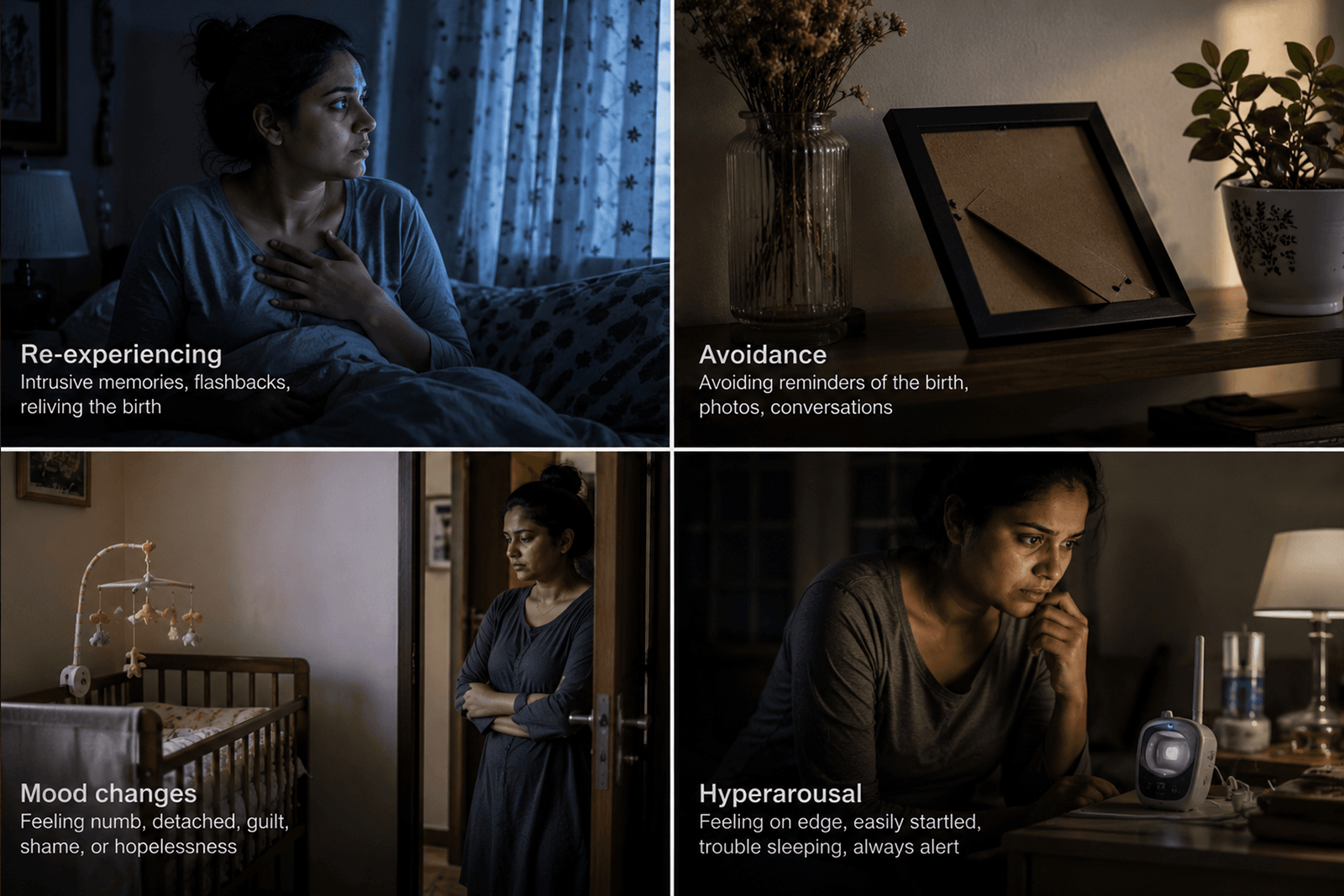
Clinically, postpartum PTSD symptoms fall into four recognized clusters. You don’t need every symptom in every category to be struggling — even a few can significantly affect daily life.
1. Re-experiencing the Birth
- Unwanted flashbacks or vivid memories of labor and delivery
- Nightmares about the birth or your baby’s safety
- Intense distress when something reminds you of the delivery (a hospital, a smell, a medical show)
2. Avoidance
- Avoiding conversations about the birth, or refusing to look at birth photos/videos
- Avoiding hospitals, doctors, or future pregnancy planning
- In severe cases, emotional distancing from the baby as a way to avoid the reminder
3. Negative Changes in Mood and Thinking
- Persistent guilt, shame, or the belief that “I failed as a mother”
- Feeling numb, detached, or disconnected from your own emotions
- Loss of interest in things you used to enjoy
4. Hyperarousal
- Feeling constantly on edge, irritable, or easily startled
- Hypervigilance about the baby’s safety beyond typical new-parent worry
- Sleep difficulties that go beyond normal newborn-related disruption
| Not sure if these symptoms apply to you? Take Maaanaya’s confidential screening in 3 minutes and get clarity on what you’re experiencing. |
What Causes a Traumatic Birth Experience?
No single factor determines who develops birth trauma or postpartum PTSD — it’s usually a combination of what happened before, during, and after delivery.
Before Birth (Antenatal Factors)
- Depression or anxiety during pregnancy
- Fear of childbirth (tokophobia)
- A history of trauma, sexual abuse, or previous difficult pregnancy/birth
- Pregnancy complications or poor physical health
During Birth (Perinatal Factors)
- Emergency or operative delivery (assisted vaginal birth or C-section)
- Feeling a lack of control, consent, or support from the care team
- Dissociation during labor — feeling detached, numb, or “outside your body”
- Obstetric complications or the baby needing NICU care
After Birth (Postpartum Factors)
- Concurrent postpartum depression
- Poor coping resources and additional life stress
- Lack of practical or emotional support at home
Research consistently identifies negative subjective birth experience and lack of support during labor as the strongest predictors — meaning how a mother felt during birth matters as much as what medically happened. This is exactly why partner presence and emotional support during delivery are protective factors, a theme we explore further in our article on the partner’s role in postpartum mental health.
The Impact on Bonding, Relationships, and Daily Life
Left unaddressed, postpartum PTSD can ripple far beyond the mother herself. Because the infant can become an unconscious reminder of the trauma, some mothers struggle with bonding, breastfeeding, or simply being alone with their baby — often accompanied by intense guilt about these feelings.
Marital strain, difficulty returning to work, and social withdrawal are also common, particularly when the people around a new mother don’t understand why she isn’t “moving on” from a birth that produced a healthy baby. If you’re also navigating the return-to-work transition on top of these feelings, our guide on balancing work and motherhood after maternity leave may help you plan that phase with more self-compassion.
A Common Story: When a “Successful” Delivery Still Feels Like Trauma
Many of the mothers Maaanaya’s care team supports describe something similar to this composite experience: Ritu, a first-time mother in her late twenties, went in for a planned vaginal delivery that turned into an emergency C-section after her baby’s heart rate dropped. The delivery itself went smoothly by medical standards, and both mother and baby went home healthy within days.
Weeks later, Ritu found herself replaying the moment doctors rushed her into the operating theatre, unable to shake the memory even during ordinary moments like bathing her baby. She avoided telling her birth story at family gatherings and felt intense guilt for not feeling the joy she thought she “should” feel. It took a chance conversation with another mother — and eventually a screening and a few sessions of trauma-focused therapy — for Ritu to understand that what she was experiencing had a name, and that it wasn’t a reflection of her strength or love for her baby.
How Is Postpartum PTSD Diagnosed and Treated?
Screening Tools
Clinicians increasingly use validated tools such as the City Birth Trauma Scale, a 29-item questionnaire developed specifically to assess birth-related PTSD in line with DSM-5 criteria (published in Frontiers in Psychiatry). If you suspect you may be experiencing symptoms, Maaanaya’s own mental health screening tool is a fast, confidential way to get an initial read and connect with a care coordinator for next steps.
-
Trauma-Focused Therapies
Trauma-focused CBT and EMDR (Eye Movement Desensitization and Reprocessing) are among the most evidence-backed treatments for birth-related PTSD. Both approaches help the brain reprocess the traumatic memory so it stops triggering the same intensity of fear. Our individual therapy & counselling sessions are designed to make this kind of specialized, trauma-informed support accessible.
-
Support Groups and Peer Connection
Hearing “me too” from another mother who understands can be as healing as clinical treatment. Maaanaya’s support groups for moms create a space where birth stories — including difficult ones — can be shared without judgment.
-
Medication
When postpartum PTSD occurs alongside significant depression or anxiety, a psychiatrist may recommend medication as part of a broader treatment plan. Maaanaya’s psychiatric support services are available for mothers who need this level of care, always alongside — never instead of — therapy and support.
| Ready to talk to someone? Connect with a trauma-informed therapist through Maaanaya’s individual therapy & counseling — you don’t have to carry this alone. |
Coping Strategies You Can Start Today
Professional support is the most reliable path to recovery, but these practices can help you manage symptoms in the meantime:
- Ground yourself in the present moment when a flashback hits — name five things you can see, four you can hear, three you can touch
- Write your birth story privately, at your own pace, without pressure to share it
- Prioritize sleep and nutrition where possible — physical depletion intensifies trauma symptoms, as we discuss in our postpartum nutrition and recovery guide
- Gentle movement, like short walks, can help regulate a nervous system stuck in “high alert”
- Limit exposure to birth content (shows, reels, other people’s birth stories) if it’s currently triggering
- Let go of the timeline — healing from birth trauma isn’t linear, and needing help doesn’t mean you’re failing at motherhood
How Partners and Family Can Help
Partners and family members play a powerful role in recovery, simply by getting a few things right:
- Avoid phrases like “at least the baby is healthy” — it can minimize real pain
- Let her tell the story as many times as she needs to, without rushing her to “move on”
- Take on practical tasks (night feeds, chores) so she has room to rest and process
- Gently encourage professional support if symptoms persist beyond a few weeks
Our full guide on the partner’s role in postpartum mental health goes deeper into specific, practical ways partners can support recovery.
When to Seek Professional Help Immediately
Reach out to a mental health professional or Maaanaya’s care team without delay if you notice:
- Symptoms lasting longer than a month and worsening rather than easing
- Difficulty functioning day-to-day or caring for your baby
- Persistent, intrusive thoughts that feel frightening or out of your control
- Severe dissociation, panic attacks, or complete avoidance of your baby
These are signs your nervous system needs professional support to reset — not evidence of personal failure. Effective, compassionate treatment exists, and reaching out early tends to lead to faster recovery.
Frequently Asked Questions
- Can birth trauma go away on its own?
Mild trauma symptoms sometimes ease naturally within a few weeks as a mother processes the experience with support from family and time. However, if symptoms persist beyond a month, worsen, or interfere with daily functioning, professional treatment such as trauma-focused therapy significantly improves and speeds recovery.
- Is postpartum PTSD the same as postpartum depression?
No. Postpartum depression is a mood disorder marked by persistent sadness and low energy, while postpartum PTSD is triggered by the specific memory of a traumatic birth and involves flashbacks, avoidance, and hyperarousal. The two conditions often occur together but require somewhat different treatment approaches.
- How long does postpartum PTSD last if untreated?
Without treatment, symptoms can persist for months or even years, particularly if reminders of the birth (like a new pregnancy) trigger a relapse. With trauma-focused therapy, most women see meaningful improvement within a few months of consistent treatment.
- Can birth trauma affect future pregnancies?
Yes. Unresolved birth trauma is linked to intense fear of childbirth in future pregnancies, avoidance of prenatal care, and requests for elective C-sections driven by fear rather than medical need. Addressing trauma before a subsequent pregnancy is strongly recommended.
- Does a C-section cause more birth trauma than vaginal delivery?
Operative births (assisted vaginal delivery or C-section) are associated with higher rates of birth trauma, largely because they’re more often unplanned or emergency procedures. However, any delivery — including a straightforward vaginal birth — can be traumatic if the mother felt frightened, unsupported, or out of control.
- How common is birth trauma among Indian mothers specifically?
A NIMHANS (Bengaluru) study found that over half of postpartum women surveyed in South India reported a negative childbirth experience, with roughly 1 in 10 meeting criteria for full or partial PTSD — see our India-specific data section above for details. These figures are likely an undercount, since postpartum PTSD isn’t routinely screened for in Indian antenatal or postnatal care.
- Where can I get help for birth trauma in India?
Start with a confidential screening to understand your symptoms, then connect with a maternal mental health platform offering trauma-informed therapy and support groups. Maaanaya offers both, along with psychiatric support for mothers who need combined care.
| Still have questions about what you’re feeling? A confidential mental health screening is a good next step, and Maaanaya’s care coordinators can guide you from there. |
Moving Forward: Healing From Birth Trauma Is Possible
Birth trauma and postpartum PTSD are real, common, and — most importantly — treatable. You don’t have to minimize your experience because your baby is healthy, and you don’t have to carry this alone waiting for it to fade on its own.
If any of this resonates, here are three steps you can take this week:
- Take a confidential mental health screening to understand what you’re experiencing
- Talk to one trusted person — a partner, friend, or care coordinator — about your birth experience, even if it feels hard to put into words
- Reach out to a maternal mental health professional who understands birth trauma specifically, not just general postpartum stress
Maaanaya’s care team specializes in exactly this kind of support. Start your free screening or explore our services to find the right next step for you.
