



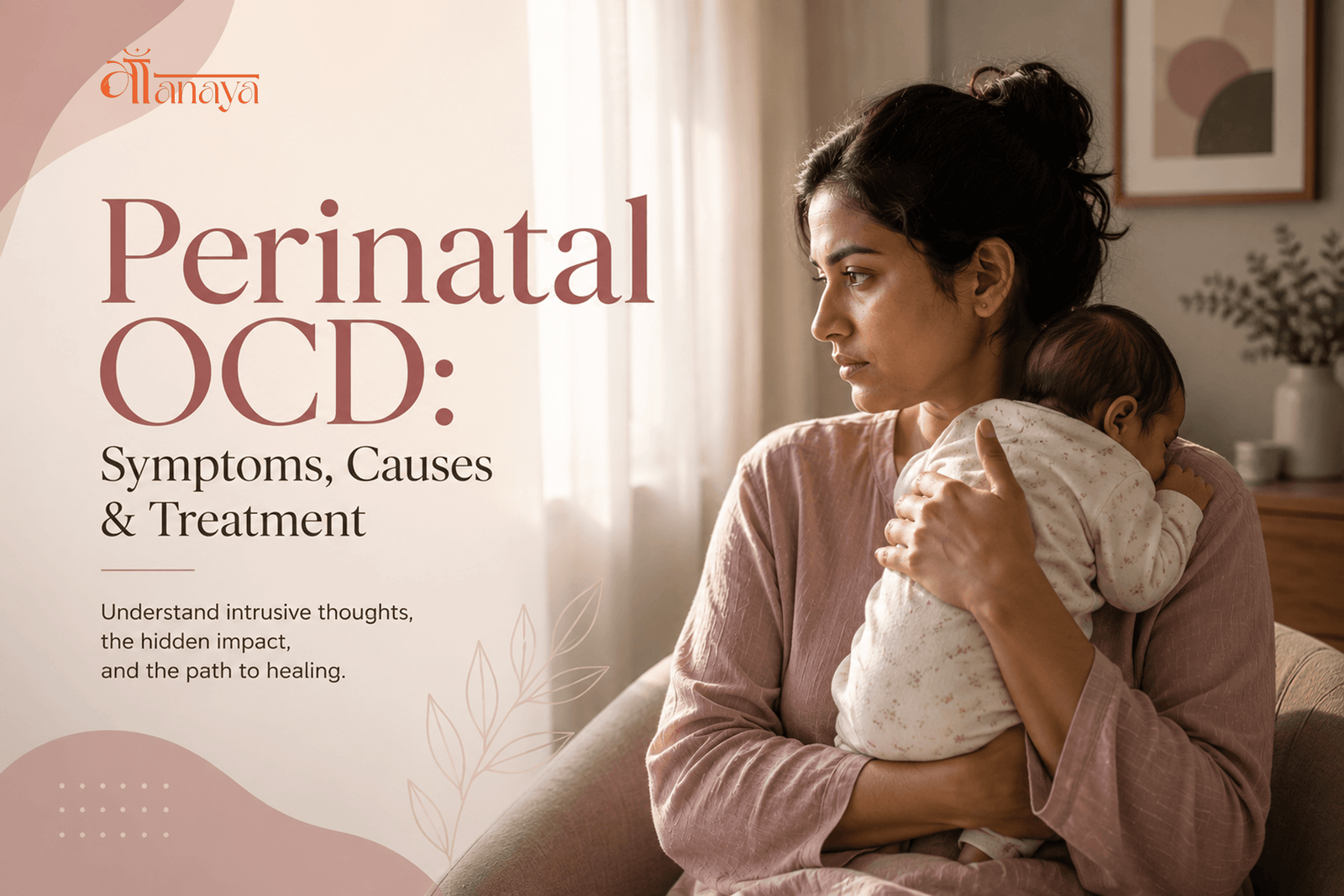
Learn about perinatal OCD symptoms, intrusive thoughts, causes, and treatment options, and discover how Maaanaya can help you find the right support.
Six weeks after her son was born, a new mother we’ll call Ritika found herself staring at the knife block in her kitchen every time she walked past it. She didn’t want to hurt her baby — but the thought that she might kept intruding, unwanted, over and over. She hid it from her husband and her doctor, and quietly decided something was deeply wrong with her as a mother.
What Ritika was experiencing has a name: perinatal OCD — one of the least talked-about, most misunderstood maternal mental health conditions, and far more common than most realize. This guide covers what it looks like, why it happens, how it’s diagnosed, and how it’s treated. If you recognize any of this in yourself: a qualified professional can help — you don’t have to sort it out alone.
Medical Disclaimer: This article is for educational purposes only and does not constitute medical advice, diagnosis, or treatment. Always consult a qualified healthcare provider — such as a psychiatrist, clinical psychologist, or your obstetrician — for concerns about perinatal OCD. If you or someone you know is in crisis, contact emergency services right away

What Is Perinatal OCD?
Perinatal OCD refers to OCD symptoms that occur during pregnancy or after childbirth — either new onset or a significant worsening of pre-existing OCD. The postpartum period is often considered to extend through the baby’s first year, though definitions vary. Like OCD in general, it has two parts: obsessions and compulsions.
- Obsessions are intrusive, unwanted thoughts, images, or urges that trigger intense anxiety. In perinatal OCD, they almost always center on the baby’s safety — fears of the infant being harmed, becoming ill, or dying.
- Compulsions are the mental or physical rituals a mother performs to neutralize that anxiety — checking, cleaning, avoiding, praying, or silently reviewing the day’s events.
The critical clinical detail is that these thoughts are typically ego-dystonic — the opposite of what the mother wants or intends, and experienced with fear and distress rather than desire. This is a professional assessment, not a self-test.
How Perinatal OCD Differs From Normal New-Parent Worry
Some protective worry is normal after having a baby — most new parents have occasional unwanted thoughts about their baby coming to harm. Having the thought once and moving on is not perinatal OCD.
What tips ordinary vigilance into a diagnosable condition is frequency, distress, and a compulsive response — thoughts that intrude repeatedly, consume significant daily time, and are followed by rigid rituals or avoidance interfering with life or bonding.
Perinatal OCD vs. Postpartum Psychosis
This distinction matters enormously — confusion between the two is a major reason mothers stay silent. Postpartum psychosis is rare but a psychiatric emergency. The table below is a general orientation, not a diagnostic tool.
| Feature | Perinatal OCD | Postpartum Psychosis |
| Nature of thoughts | Intrusive thoughts, images, or urges that are typically unwanted and distressing | May involve delusions or hallucinations that can feel real or justified to the person experiencing them |
| Insight | Usually preserved — the person recognizes the thoughts as unwanted or unreasonable, though insight can vary | May be impaired |
| Hallucinations/delusions | Not a feature of OCD | May be present |
| Behavior pattern | Compulsions (checking, avoidance, reassurance-seeking) and significant distress | May include severe confusion, disorganization, paranoia, or markedly altered reality testing |
| Clinical urgency | Warrants a mental health evaluation | A psychiatric emergency requiring urgent assessment |
| Typical onset | Can begin during pregnancy or postpartum, often gradually | Most commonly emerges early in the postpartum period, though timing varies |
If you’re ever genuinely unsure which pattern applies, treat it as urgent and reach out to a mental health professional immediately.
How Common Is Perinatal OCD?
Perinatal OCD is far more common than the silence around it suggests:
- One widely cited analysis puts prevalence at 7.8% during pregnancy and 16.9% postpartum — several times higher than OCD’s roughly 1–2% lifetime prevalence generally.
- Stricter DSM-5-based studies estimate postpartum OCD at 2–9% of new mothers, with new-onset OCD in around 9% of women with no prior diagnosis.
- Subclinical intrusive thoughts of infant-related harm are reported by roughly half of all new mothers — having the thought is common; the loop of anxiety and ritual defines the disorder.
- Over 40% of women with postpartum depression also report intrusive thoughts of harm to their infant.
In India, dedicated data is limited, but common mental disorders affect a substantial share of women perinatally, and institutions like NIMHANS have run specialized services since 2006 — reflecting a gap in routine screening. If your worry looks more like constant dread than ritualized thoughts, our guide on postpartum anxiety may be more relevant.

Symptoms of Perinatal OCD
Symptoms fall into three buckets: intrusive thoughts, rituals used to manage them, and the physical and emotional toll of both.
Common Obsessions (Intrusive Thoughts)
- Fears of accidentally harming the baby — dropping, drowning, or suffocating them.
- Thoughts of intentionally harming the baby can also occur as intrusive obsessions, typically unwanted and inconsistent with the person’s values — a clinician is best placed to distinguish this from genuine risk.
- Contamination fears about germs or illness.
- Fear of sudden infant death syndrome (SIDS) or the baby stopping breathing unnoticed.
- Unwanted sexual intrusive thoughts involving the baby — among the most stigmatized symptoms, and a well-documented OCD symptom, not a sign of intent.
Common Compulsions
- Repeated checking of breathing, temperature, or sleeping position.
- Excessive cleaning or sterilizing of bottles, hands, or surfaces well beyond typical hygiene.
- Avoidance of stairs, bathtime, knives, or being alone with the baby.
- Mental reviewing or repeated reassurance-seeking (“Are you sure the baby’s okay?”).
- Silent counting, praying, or ritual sequences to “cancel out” the thought.
Physical and Emotional Signs
- Sleep disruption beyond normal newborn exhaustion, from rituals or checking.
- Hypervigilance — a constant sense of being “on duty.”
- Shame and secrecy, often driven by fear that disclosure will get the baby taken away.
- Overlap with postpartum depression and anxiety, which clinicians routinely screen for together.
What Causes Perinatal OCD?
There is no single cause, and it is not caused by anything a mother did wrong. Contributing factors include:
- Hormonal and biological changes during pregnancy and after childbirth.
- Sleep deprivation, which is well established as a trigger and amplifier for obsessive-compulsive symptoms.
- The natural rise in vigilance that comes with a newborn, which can tip into a persistent anxiety loop in a vulnerable nervous system.
- A personal or family history of OCD, anxiety, or perfectionistic traits.
- A traumatic pregnancy, delivery, or NICU stay — see our piece on birth trauma and postpartum PTSD for overlapping symptoms.
- Limited social support and pressure — especially strong in many Indian households — to appear composed immediately after childbirth.
How Perinatal OCD Is Diagnosed
Diagnosis happens through clinical evaluation, not a self-administered checklist. A psychiatrist or clinical psychologist will typically:
- Take a detailed history of the thoughts, frequency, and rituals or avoidance.
- Use validated screening tools for OCD alongside anxiety and depression screeners, since the three often co-occur.
- Rule out postpartum psychosis and assess risk carefully.
- Confirm the diagnosis against DSM-5 criteria for OCD, applied to the perinatal context. Routine mental health check-ups during pregnancy make early detection far more likely.
If you’re unsure where to start, Maaanaya’s mental health screening can be a first step. It is not a diagnostic tool and takes only a few minutes.
Start the Maaanaya mental health screening → Maaanaya Patient

How to Get Help: Treatment for Perinatal OCD
Effective treatments exist, and many people improve significantly with the right combination of therapy, medical guidance, and support.
Exposure and Response Prevention (ERP) Therapy
ERP is the gold-standard psychotherapy for OCD, including its perinatal form. With a trained therapist, a mother gradually faces the situations or thoughts that trigger anxiety without performing the usual compulsion, which over time softens the obsession-compulsion loop. ERP should be planned with a therapist trained in OCD, not attempted as self-treatment.
Building a Support System
- Individual therapy offers a confidential space to name the thoughts aloud without judgment. Explore individual therapy & counseling.
- Support groups connect mothers with others who’ve had similar thoughts — often the most shame-reducing part of recovery. See Maaanaya’s support groups for moms.
- Partner and family involvement matters — a partner who understands the condition is less likely to reinforce compulsions through constant reassurance. See a partner’s role in postpartum mental health.
Supporting a Loved One With Perinatal OCD
If someone has confided a scary, intrusive thought to you:
- Don’t panic or treat the disclosure as a confession of danger — it’s the opposite: a sign she’s fighting the thought, not acting on it.
- Avoid reassurance-seeking loops (“Are you sure you didn’t…?”), which can reinforce the OCD cycle.
- Encourage a professional evaluation rather than trying to talk her out of the thoughts yourselves.
- Take practical pressure off — sleep, meals, and a break from being “on duty” alone help recovery.
Frequently Asked Questions
Is perinatal OCD the same as postpartum depression?
No. They can occur together, but postpartum depression centers on persistent low mood, while perinatal OCD centers on intrusive thoughts and compulsions. A clinician can help sort out which — or both — apply.
Will my scary thoughts make me hurt my baby?
Intrusive thoughts in perinatal OCD are typically unwanted and inconsistent with the person’s own intentions — having the thought doesn’t mean you want to act on it. A qualified professional should still assess anyone experiencing these thoughts.
How long does perinatal OCD last?
Untreated, symptoms can persist and fluctuate with sleep and stress. Effective treatments exist, and many people improve significantly with care.
Can perinatal OCD start during pregnancy, not just after birth?
Yes. “Perinatal” includes pregnancy through the baby’s first year, and symptoms can begin at any point in that window, including new-onset OCD with no prior history.
Is it safe to take OCD medication while breastfeeding?
Many SSRIs are considered compatible with breastfeeding, but the right decision depends on the specific medication, dose, and health history — discuss this directly with a psychiatrist.
When should I see a doctor about intrusive thoughts?
If thoughts are frequent, distressing, or accompanied by rituals or avoidance that interfere with bonding or daily life, it’s time for a professional evaluation — sooner rather than later.
Key Takeaways
Perinatal OCD thrives on secrecy. Describing the thought out loud to a professional who won’t panic is one of the most helpful steps a person can take.
- Unwanted, intrusive thoughts about your baby’s safety are common — the disorder is defined by the loop of anxiety and ritual, not by having the thought itself.
- Perinatal OCD and postpartum psychosis are clinically distinct, but only a qualified professional can reliably tell them apart — treat real uncertainty as urgent.
- ERP therapy, and in many cases medication, are established, well-studied treatments — you don’t have to manage this alone.
- Sharing these thoughts with a qualified mental health professional is an important step toward getting the right assessment and support.
If any of this sounds familiar, you don’t need to have it all figured out before reaching out. A short, confidential screening is often a manageable first step.
Take the Maaanaya mental health screening → | Contact our care team → Maaanaya Patient
.
