



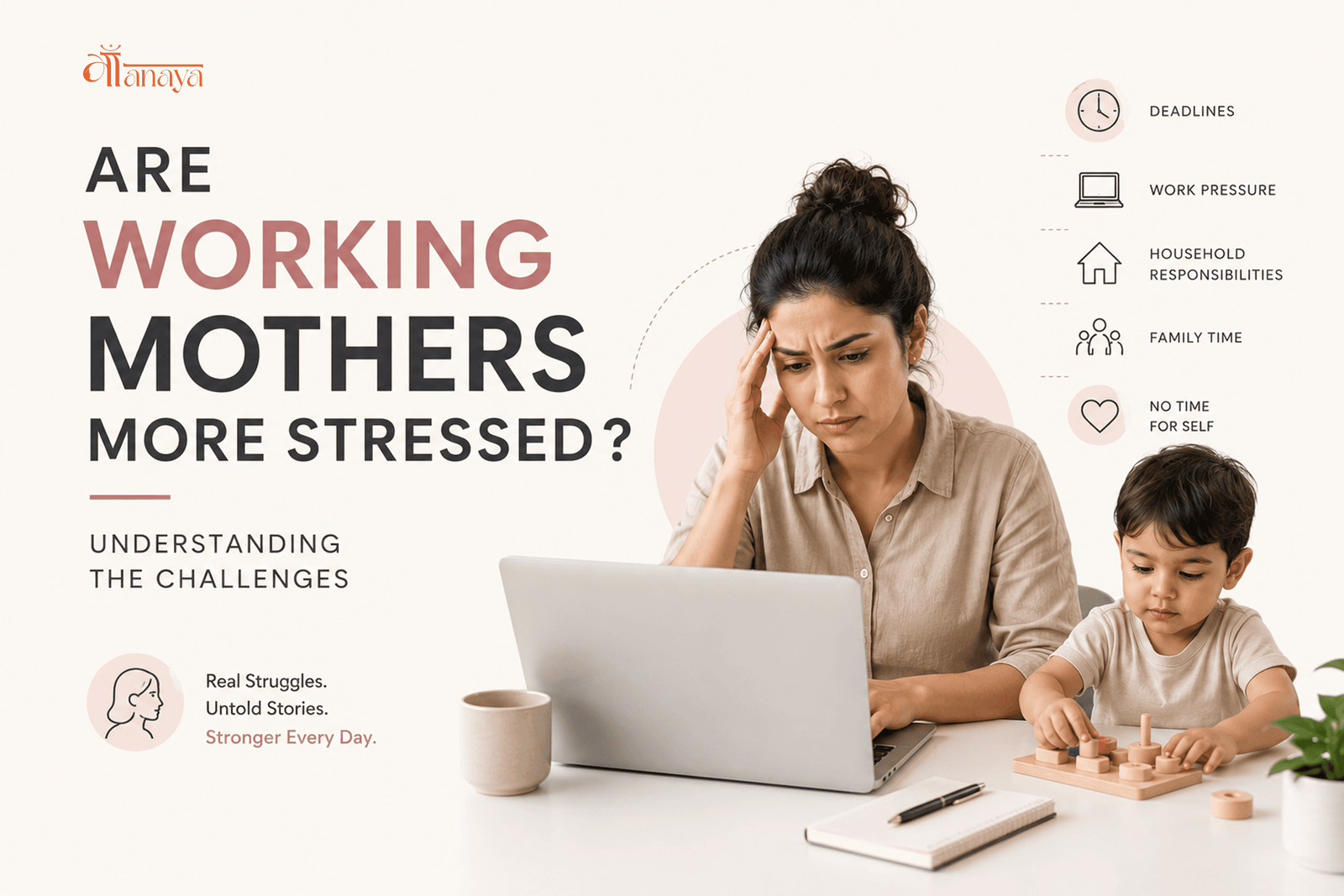
Are working mothers more stressed than others? Explore the research, real causes, warning signs, and expert-backed ways to manage stress.
It’s 11 p.m. The lunchboxes are packed, the inbox still has unread messages from your manager, and your child’s school WhatsApp group just pinged about tomorrow’s “fancy dress day.” If you’re a working mother reading this at the end of a day like that, you already know the answer to the question in the title. But it helps to know why it feels this way — and what actually helps.
This isn’t a guilt-trip article. It’s a look at what research, mental health professionals, and thousands of Indian working mothers say about stress, so you can recognise it earlier, understand where it comes from and find support before it turns into burnout.
Are Working Mothers More Stressed? What the Research Actually Shows
Short answer: yes, on most validated measures, working mothers report meaningfully higher stress than non-working mothers and than working fathers — though the gap depends heavily on support systems, workplace flexibility, and family structure.
A cross-sectional study published in the International Journal of Community Medicine and Public Health used the Perceived Stress Scale to assess professionally working mothers and found that moderate to severe stress was reported by roughly 63% of participants.
📊 63% of professionally working mothers reported moderate to severe stress on the Perceived Stress Scale
Similarly, a 2025 cross-sectional study out of Meerut, Uttar Pradesh, using the same validated scale, found that 72% of working mothers experienced moderate stress and another 18% reported high stress — leaving only 1 in 10 with low stress levels.
📊 72% of working mothers in a 2025 Uttar Pradesh study reported moderate stress; 18% reported high stress.
A separate comparative study on parenting stress found that working mothers were about twice as likely as non-working mothers to report high parenting-stress scores.
📊 26% of working mothers experienced high parenting stress, vs. 13% of non-working mothers — roughly double.
And a 2025 study in Frontiers in Global Women’s Health, looking at women across public and private sector jobs in Tamil Nadu, identified workload, job insecurity, lack of support, and work-life imbalance as the leading drivers of workplace stress for Indian working women.
Globally, the picture is consistent. The American Psychological Association’s research on parental burnout has repeatedly found that parents — mothers especially — report disproportionately high stress linked to the “mental load” of running a household alongside a job; in 2023, a third of parents rated their stress as high, compared to a fifth of adults without children. Gallup research, cited in recent reporting on the mental load of parenthood, also notes that working mothers are twice as likely as fathers to consider reducing their hours or leaving the workforce altogether because of caregiving pressure.
None of this means motherhood or work are inherently harmful. What the data consistently points to is a structural mismatch — women are managing two full-time roles with support systems (workplace policy, household task-sharing, mental health resources) that haven’t caught up.

What Makes Working-Mother Stress Different
Stress itself isn’t unique to mothers. What’s different is the shape of it. Working-mother stress tends to be:
- Chronic rather than acute. It’s not one hard day — it’s a low hum of pressure that rarely switches off, because there’s no real “end of shift” between office and home.
- Cognitive, not just physical. Much of it is invisible mental tracking — school forms, vaccination dates, whose turn it is to do pickup — sometimes called the “mental load.”
- Tied to identity. Many mothers describe guilt as a bigger stressor than the workload itself — guilt about missing a school event, guilt about being distracted at work, guilt about needing help at all. Our piece on the emotional transition from woman to mother goes deeper into this identity shift.
- Compounded by culture. In many Indian households, domestic and childcare responsibilities are still assumed to be the mother’s default job, regardless of her work hours — a pattern several of the Indian studies above name explicitly as a driver of higher stress scores.
The Core Reasons Working Mothers Experience Higher Stress
- The “Second Shift”
Paid work doesn’t reduce a mother’s share of housework and childcare nearly as much as it should. Multiple Indian studies on working women describe this as a “dual role” — a full workday followed by a second, unpaid one at home. Over time, this leaves little room for rest, exercise, or sleep, and several of the studies cited above link it directly to physical symptoms like headaches, fatigue, and low energy.
- Mental Load and Invisible Labour
Even when partners share physical tasks, the planning and remembering — birthdays, doctor’s appointments, what’s running low in the pantry — usually still sits with the mother. Research on cognitive overload and invisible labour in working women links this mental tracking to measurable increases in psychological distress, independent of how many physical chores are actually shared.
- Maternal Guilt and Societal Expectations
A recent scale-development study on Indian working mothers in the IT sector identified maternal guilt as one of four core stress factors, alongside career pressure, weak support systems, and low self-efficacy. Guilt tends to spike around milestones — first day of school, missed recitals — and can quietly erode confidence at work too.
- Limited Workplace Flexibility
Rigid hours, unsupportive managers, and short or unpaid maternity-return transitions all add pressure. Our guide on balancing work and motherhood after maternity leave covers this transition period in more detail, including what a fair return-to-work plan can look like.
- Sleep Deprivation and Physical Health Decline
Poor sleep isn’t just uncomfortable — it lowers stress tolerance itself, creating a cycle where fatigue makes every other stressor feel bigger. Indian research on working mothers consistently flags disrupted sleep and low energy as some of the most commonly reported symptoms.
- Weak or Absent Support Systems
Nuclear family living, limited paid leave, and inconsistent childcare options all remove the natural buffers that used to soften this load. Several studies note that mothers with strong family or partner support report meaningfully lower stress scores than those without it — which is exactly why structured support, like support groups for moms, matters as much as individual coping skills.

Signs Your Stress Has Crossed Into Burnout
Everyday stress and burnout aren’t the same thing. Watch for:
- Feeling emotionally numb or detached from your child, partner, or work — most days, not just occasionally
- Persistent exhaustion that doesn’t improve with a good night’s sleep
- Irritability or a short temper that feels out of character
- Losing interest in things you used to enjoy
- Physical symptoms — headaches, muscle tension, stomach issues — with no clear medical cause
- Feeling like you’re “just getting through” each day rather than living it
- Difficulty concentrating or making decisions, even small ones
If several of these have been true for more than two weeks, it’s worth treating this as more than “just a busy phase” and considering professional support.
How Working Mothers Can Manage and Reduce Stress

At Work
- Name your capacity out loud. Tell your manager what’s realistic, especially in the months after returning from leave.
- Protect blocks of focused time. Even 90 minutes without interruptions can meaningfully cut end-of-day exhaustion.
- Use every benefit available. Flexible hours, work-from-home days, and childcare allowances exist precisely for this — using them isn’t a weakness.

At Home
- Make the mental load visible. Write out every recurring task — physical and cognitive — and split the list explicitly with your partner or household, rather than assuming it’ll balance itself out.
- Lower the bar on non-essentials. Not every day needs a home-cooked three-course dinner or a spotless house.
- Build in recovery, not just rest. A walk, five minutes of quiet, or a short call with a friend can lower cortisol more effectively than scrolling on a phone.
For Your Mind
- Talk to someone trained for this. A counsellor can help you separate what’s genuinely urgent from what guilt is telling you is urgent. Individual therapy and counselling is designed exactly for this kind of ongoing, structural stress — not just crisis moments.
- Don’t do it alone. Peer support from other mothers navigating the same juggling act can reduce isolation significantly; explore Maaanaya’s support groups for moms if you’d like structured peer support.
- Revisit your sense of self beyond “mother” and “employee.” Our piece on how therapy unlocks self-understanding is a good starting point if you feel like your identity has narrowed since becoming a parent.
When to Seek Professional Support
Reach out for professional help if:
- Stress or low mood has lasted more than two weeks and isn’t improving
- You’re relying on avoidance, overeating, or substances to cope
- You feel disconnected from your child or partner
- Friends or family have expressed concern about your mood or energy
- You’ve had thoughts of harming yourself or feel you can’t go on — this needs urgent, immediate support, not a “wait and see” approach
Maaanaya offers a free, confidential mental health screening that takes a few minutes and gives you instant results, with a care coordinator following up if you need next steps. If you’d rather speak with someone directly, our team is reachable through the contact page.
FAQs on Working Mothers and Stress
- Are working mothers more stressed than stay-at-home mothers?
On most validated stress scales, yes — several Indian studies show meaningfully higher scores among working mothers, largely because they’re managing two full sets of responsibilities with limited extra support. However, stay-at-home mothers face their own distinct stressors, including isolation and loss of professional identity, so it isn’t a simple “easier vs harder” comparison.
- What is the biggest cause of stress for working mothers?
Research points to the combined effect of the “second shift” (unpaid work after paid work), the invisible mental load of planning and remembering, and maternal guilt — rather than any single factor alone.
- How can a working mother reduce stress quickly?
Short-term relief comes from making the mental load visible and explicitly shared, protecting small pockets of recovery time daily, and lowering self-imposed standards on non-essential tasks. Longer-term relief usually needs structural changes — flexible work, shared caregiving, and professional support.
- Is working-mother stress the same as postpartum depression?
No. Chronic work-life stress and postpartum depression are different, though they can overlap and worsen each other. If low mood, hopelessness, or detachment from your baby persist, it’s worth a professional evaluation rather than assuming it’s “just stress.”
- Can workplace policies actually reduce stress for working mothers?
Yes — studies on maternity leave extensions and flexible-work access consistently correlate with lower psychological distress among working mothers, reinforcing that this isn’t only an individual coping problem.
- When should a working mother consider therapy?
If stress, irritability, or exhaustion have lasted more than two weeks, are affecting your relationships or work, or if you notice guilt or numbness that won’t lift, that’s a reasonable point to bring in professional support rather than waiting for a crisis.

Key Takeaways
Working mothers do, on average, carry a heavier stress load — not because motherhood or careers are inherently at odds, but because the support systems around both haven’t kept pace with what’s being asked of women managing them together. The good news: stress that’s named and structurally addressed — at work, at home, and through professional support — is manageable.
If today’s version of you recognises more of this article than you’d like, that’s worth taking seriously rather than pushing through. Take Maaanaya’s free mental health screening, explore individual counselling or support groups for moms, or simply reach out to talk it through. You don’t have to carry this alone.
