



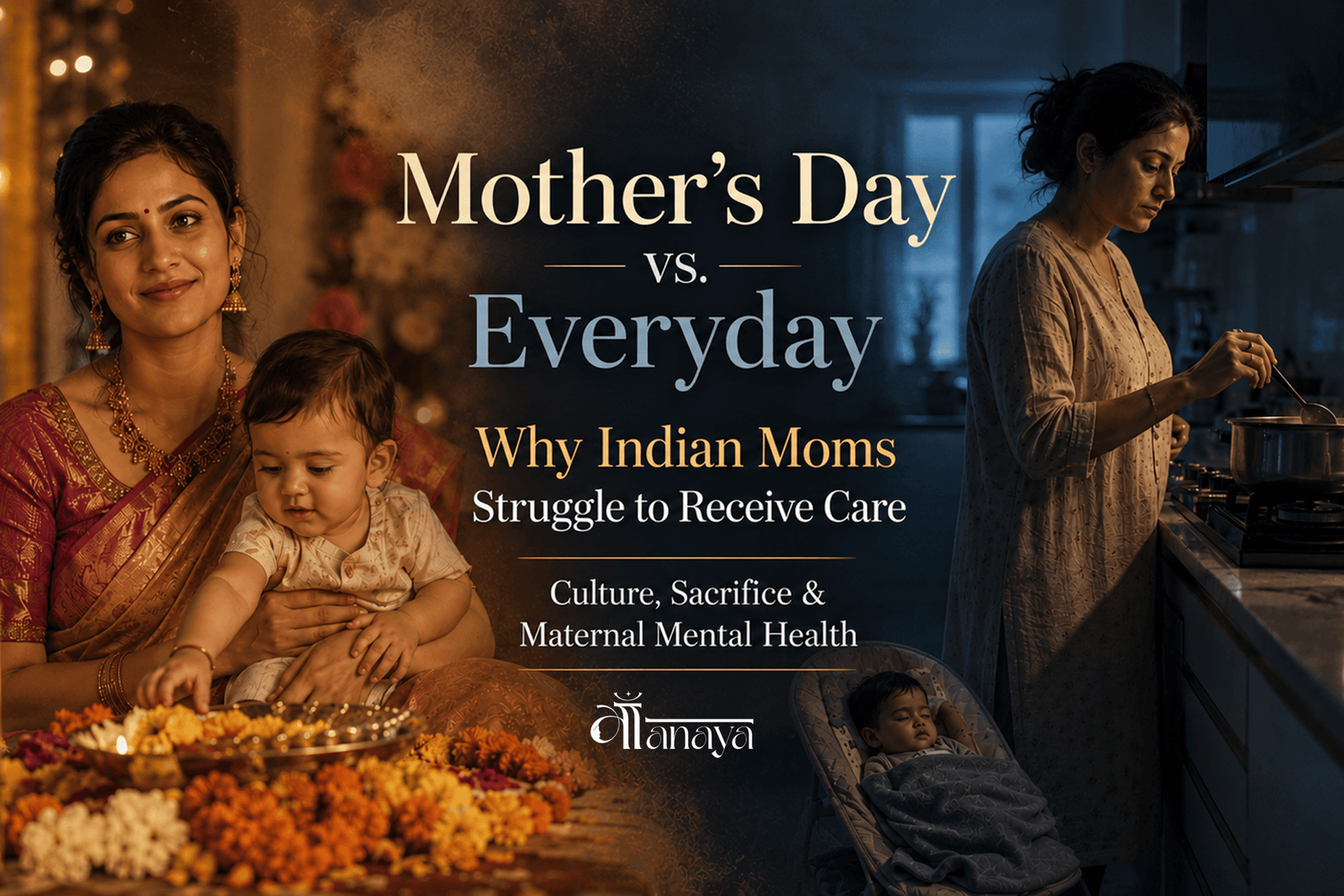
Indian moms give endlessly but rarely know how to receive care. Explore the cultural guilt behind Mother’s Day celebrations and how maternal mental health support can help.
Introduction: The Paradox of the Celebrated Indian Mother
Every May, India collectively turns its attention to Indian moms — flowers are gifted, WhatsApp messages flood in, and social media fills with heartfelt tributes. And yet, in the very same homes where these celebrations unfold, millions of Indian mothers quietly wrestle with exhaustion, emotional overwhelm, and a guilt that arrives uninvited the moment someone tries to care for them.
Indian moms and maternal mental health are deeply intertwined in a way that our culture rarely acknowledges. The same woman who will go without sleep to comfort a crying infant, who will skip lunch to finish household work, and who will suppress her own grief to hold the family together — this same woman will feel awkward, even wrong, when her children say “Amma, sit down. Rest today.”
Mother’s Day is a beautiful gesture. But for many Indian mothers, it also exposes a painful truth: they have been so thoroughly conditioned to give that they no longer know how to receive. This is not weakness. It is the weight of generations. And it has profound consequences for Indian moms’ maternal mental health, particularly in the postpartum period when professional care is most urgently needed.
This blog explores the cultural, psychological, and emotional dimensions behind why Indian mothers struggle to accept care — and why platforms like Maaanaya exist to bridge that gap with compassion, not judgment.
The Cultural Architecture of Self-Sacrifice
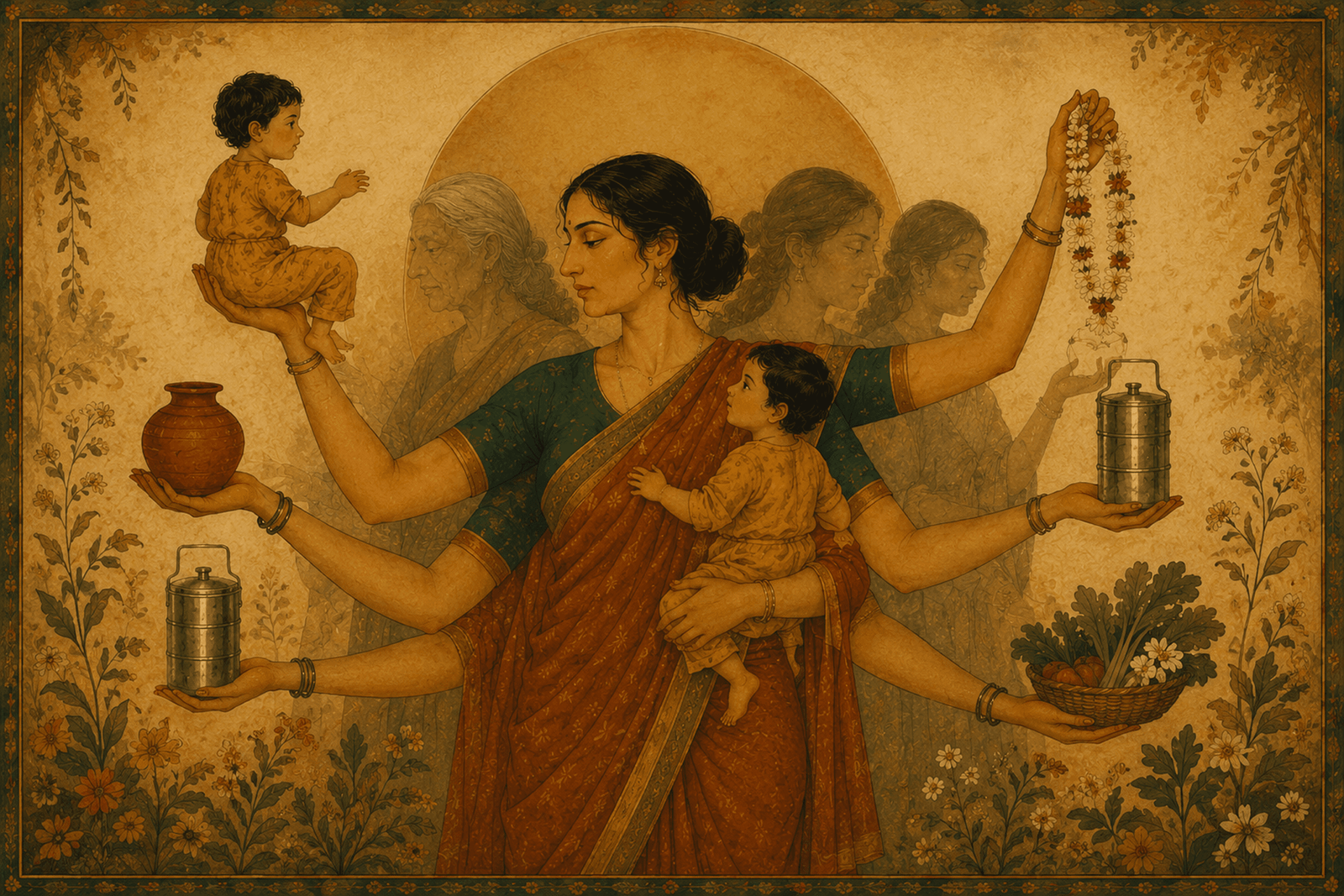
Indian motherhood is not simply a role — it is an identity built brick by brick through centuries of cultural storytelling. From the mythological ideal of Sita’s patience to the enduring image of the “Bharat Mata,” Indian society has long equated great motherhood with great sacrifice.
The Mythology of the Self-Less Mother
In Indian literature, cinema, and everyday conversation, the ideal mother is one who wants nothing for herself. She fasts on festivals. She eats last. She is the first one up and the last one to sleep. This image is so deeply embedded in the cultural imagination that many mothers unconsciously measure their own worth against it.
Research in cross-cultural psychology consistently shows that collectivist cultures — which include most of South Asia — place the family unit’s wellbeing above the individual’s. For mothers in these contexts, prioritising personal needs can trigger genuine feelings of moral failure.
The Guilt Mechanism
The guilt is not external alone. Many Indian mothers have internalized these values so deeply that care offered to them triggers an automatic inner voice: “Others need this more than I do.” This cognitive pattern, where self-care is reframed as selfishness, is one of the most significant barriers to seeking help for postpartum anxiety and emotional recovery in India.
When well-meaning family members say, “Why are you seeing a therapist? You have everything,” they are echoing a cultural script — not being deliberately cruel. The script says: a good mother manages. A good mother does not need help. And for new mothers navigating postpartum wellness in India, this script can be genuinely dangerous.
Why Receiving Care Feels Uncomfortable for Indian Mothers
The discomfort Indian mothers feel when they are the recipient of care is not random. It has identifiable psychological and social roots.
1. Identity Fusion With the Caregiver Role
Many Indian mothers have built their entire sense of self around caregiving. When someone else takes on that role — even temporarily — it can feel disorienting. “Who am I if I am not the one who gives?” This identity crisis often manifests as restlessness, guilt, or insistence on doing tasks even when physically or emotionally depleted.
2. Transgenerational Modelling
Most Indian women grew up watching their own mothers never rest, never complain, never ask for help. These behaviours are modelled across generations. A daughter who watched her mother refuse help at every turn will struggle to accept it herself — not because she agrees with it intellectually, but because it is what her nervous system recognises as normal.
3. Fear of Being Perceived as Weak
In many Indian households, asking for help — especially emotional help — is associated with weakness or instability. This stigma around mental health in India affects women disproportionately. Seeking support for postpartum anxiety or emotional recovery after childbirth can feel like admitting a failure rather than exercising wisdom.
4. The Invisible Labour Bind
Indian mothers are often responsible for “managing” the household emotionally as well as practically. This includes managing everyone else’s perceptions of her own wellbeing. Even when struggling, many mothers perform wellness — appearing fine to protect those around them from worry.
Mother’s Day vs. Everyday — A Tale of Two Realities
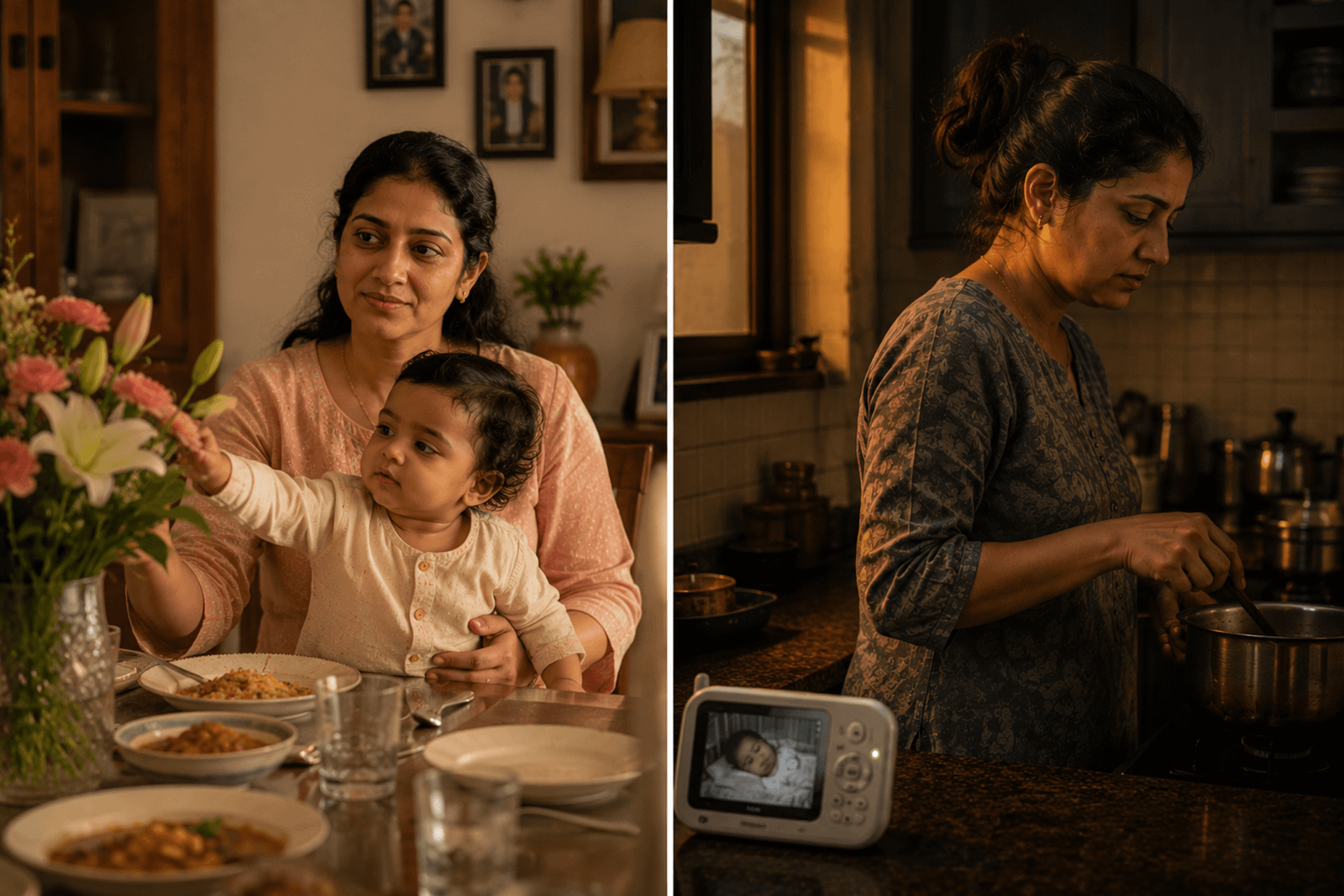
Mother’s Day strips back the everyday and puts care on display in a concentrated, sanctioned way. It is acceptable — expected, even — to fuss over a mother on this one day. But this very exceptionalism reveals a troubling normal: the rest of the year, her needs are background noise.
The Mother’s Day Performance
For many Indian mothers, Mother’s Day is experienced with warmth and a quiet undercurrent of awkwardness. The children are attentive. The husband may have bought a cake. Someone insists she sit while they cook. And throughout it all, she may feel genuinely uncomfortable — asking if anyone has eaten, checking on the dal, reaching for the broom.
This is not ingratitude. It is the lived experience of a woman who has been conditioned to believe that her worth is tied to her function. When her function is temporarily suspended by celebration, her sense of self briefly loses its anchor.
The Everyday Reality
On most other days, Indian mothers navigate:
- Waking before the household stirs
- Managing school schedules, meals, and emotional crises
- Often working full-time jobs in addition to household responsibilities
- Suppressing postpartum physical and emotional symptoms to appear capable
- Rarely, if ever, scheduling time for their own mental health or wellness
The gap between the celebrated Mother’s Day version of motherhood and its daily reality is where Indian moms’ maternal mental health quietly fractures — not all at once, but steadily, like a slow leak.
Case Study: When Celebration Becomes Guilt
Priya, 34, Bangalore — Mother of a 9-month-old
Priya had been struggling silently since her daughter’s birth. She had not slept more than three consecutive hours in months, felt detached from her own body, and experienced persistent anxiety she had not told anyone about — not even her husband.
On Mother’s Day, her in-laws surprised her with flowers and insisted she spend the day without any chores. Her husband cooked breakfast. By noon, Priya was in the kitchen anyway — not because she was asked, but because the stillness made her anxious and the attention made her feel guilty. She told herself, “They’re doing so much for me. I should be happy. Why do I feel worse?”
That evening, she cried in the bathroom so no one would see.
When Priya eventually reached Maaanaya, she began working with a licensed therapist who helped her understand that her inability to rest was not laziness or ingratitude. It was a deeply conditioned response — and one that was directly connected to her unaddressed postpartum anxiety.
Over several sessions, Priya learned that receiving care gracefully is not passive. It is, in fact, an act of courage for women like her. She also began to see that asking for help was not a sign of failing her family. It was how she could become more present for them.
What Priya’s Story Teaches Us: The guilt of being celebrated on Mother’s Day is not about the celebration itself. It is the concentrated expression of a year-round belief system that frames maternal sacrifice as virtue and maternal need as inconvenience.
Mother’s Day vs. Daily Care — A Comparison
| Dimension | Mother’s Day | Everyday |
| Attention to Mother’s Needs | High — concentrated, visible | Low — assumed, invisible |
| Emotional Permission to Rest | Socially sanctioned | Rarely given or taken |
| Acknowledgement of Labour | Explicit, celebrated | Largely invisible |
| Mother’s Internal Experience | Often guilt, awkwardness | Exhaustion, invisibility |
| Access to Mental Health Support | Not usually discussed | Stigmatised, rarely sought |
| Cultural Messaging | “You deserve this one day” | “A good mother doesn’t need anything” |
| Physical Care | Temporary relief | Rarely prioritised postpartum |
| Maaanaya’s Role | Raises awareness | Provides ongoing, accessible support |
The comparison above illustrates a fundamental mismatch: the care offered on Mother’s Day is real and well-intentioned, but it is structured as a temporary exception rather than a sustained practice. What Indian mothers — especially those in the postpartum period — actually need is consistent, professional, and shame-free access to mental health support and wellness care.
Nutrition and Food Essentials for a Mother’s Emotional Health.
While therapy and professional support are central to postpartum wellness in India, food plays a deeply intertwined role in a mother’s emotional and physical recovery. Traditional Indian wisdom has long understood this, even if modern conversations have moved away from it.
Why Postpartum Nutrition Affects Maternal Mental Health
After childbirth, a mother’s body undergoes significant hormonal and nutritional shifts. Deficiencies in specific nutrients are directly linked to worsened mood, increased anxiety, and reduced emotional resilience — all of which compound the cultural pressures Indian mothers already face.
Key Nutrients for Emotional Wellbeing in New Mothers
1. Iron Postpartum anaemia is extremely common among Indian mothers, particularly those who experienced blood loss during delivery. Low iron levels are associated with fatigue, brain fog, and depressive symptoms. Foods rich in iron include spinach, lentils (dal), sesame seeds (til), and jaggery — all staples in traditional Indian postpartum diets for good reason.
2. Omega-3 Fatty Acids Research links omega-3 deficiency to increased risk of postpartum depression. Flaxseeds, walnuts, and mustard oil — commonly used in Indian cooking — are excellent plant-based sources. Where advised by a healthcare provider, fish oil supplementation may also be recommended.
3. Vitamin D Despite abundant sunshine, Vitamin D deficiency is widespread across India. Low Vitamin D is associated with mood disorders and immune compromise. Time in morning sunlight and foods like eggs and fortified dairy can help, alongside medical supplementation when needed.
4. Magnesium Magnesium supports nervous system regulation and helps reduce anxiety. Bananas, dark leafy greens, and cashews — all common in Indian kitchens — are rich sources.
5. Protein Adequate protein supports hormone production and sustained energy. Dals, paneer, curd, eggs, and legumes are culturally familiar and effective sources for postpartum recovery.
Traditional Indian Foods That Support Postpartum Wellness
Indian culture has always had a rich tradition of postpartum care foods (called jaappa or confinement diet in different regions):
- Gondh ke ladoo (edible gum ladoos): Rich in calcium and energy, traditionally given to new mothers for bone strength and stamina.
- Ajwain water: Supports digestion and reduces postpartum bloating.
- Haldi doodh (golden milk): Anti-inflammatory, supports healing and sleep.
- Dry fruit and nut mixes: Provide healthy fats, iron, and sustained energy.
- Methi (fenugreek) preparations: Support lactation and hormone balance.
These traditional practices carry genuine nutritional wisdom. However, when a mother is experiencing postpartum anxiety or depression, food alone is not sufficient. Professional mental health support remains essential — and this is precisely where platforms like Maaanaya become critical.
How Maaanaya Is Changing the Way Indian Moms Receive Support
Maaanaya is a digital platform specifically designed to address the gap in maternal mental health and postpartum wellness support in India. In a landscape where seeking help is still deeply stigmatised, and where new mothers often cannot leave their homes easily, Maaanaya offers something quietly revolutionary: accessible, professional, compassionate care — on her terms.
What Maaanaya Offers
Licensed Mental Health Professionals Maaanaya connects mothers with therapists and counsellors who specialise in maternal mental health — professionals who understand postpartum anxiety, emotional overwhelm, identity shifts, and the specific cultural pressures Indian mothers navigate.
Postpartum Care and Guidance Beyond therapy, Maaanaya offers structured support for emotional recovery after childbirth, navigating relationship changes that come with becoming a parent, and managing the transition into motherhood with professional guidance.
Holistic Wellness Approach Maaanaya recognises that postpartum wellness is not only psychological. The platform brings together psychologists, therapists, and physiotherapists to address both the emotional and physical dimensions of recovery after childbirth.
Digital Access From Home Perhaps most critically: Maaanaya’s services are accessible online. A mother who cannot leave her newborn, who lives in a city without accessible specialists, or who simply needs support at 11pm when everyone else is asleep — she can reach Maaanaya.
Why This Matters for Indian Moms
The cultural conditioning explored throughout this blog — the guilt, the self-sacrifice, the discomfort with receiving care — does not disappear overnight. But having access to a professional who can name these patterns, contextualise them, and work through them with compassion is genuinely life-changing.
Maaanaya’s mission is not to ask Indian mothers to abandon their values. It is to ensure that care for others does not come at the cost of self-destruction. It is to say, quietly but clearly: your mental health matters, your recovery matters, and you are allowed to receive help.
FAQ
Q1: Why do Indian mothers feel guilty when people try to take care of them?
Indian mothers often feel guilty receiving care because generations of cultural conditioning have tied their identity and self-worth to being caregivers. Receiving care can feel unfamiliar, even selfish, because the cultural script frames maternal sacrifice as a virtue. This guilt is not personal failure — it is a deeply ingrained social pattern that can be gently unlearned with the right support.
Q2: Is postpartum anxiety common among Indian mothers?
Yes. Postpartum anxiety and postpartum depression affect a significant number of mothers globally, and Indian mothers are not exempt. However, due to cultural stigma and lack of awareness, many Indian mothers do not seek help. Symptoms like persistent worry, emotional numbness, irritability, and trouble bonding with a baby should always be discussed with a qualified professional.
Q3: How is Mother’s Day experienced differently by Indian mothers compared to Western mothers?
For many Indian mothers, Mother’s Day carries a unique emotional complexity. While the celebration is welcomed, the cultural conditioning to suppress personal needs often makes receiving attention feel uncomfortable or guilt-inducing. Western cultural frameworks more openly normalise self-care for mothers; Indian cultural frameworks still largely equate great motherhood with selflessness, making sanctioned celebration feel at odds with the mother’s deeply held self-concept.
Q4: What foods help with postpartum mental health recovery in India?
Foods rich in iron, omega-3 fatty acids, magnesium, protein, and Vitamin D support emotional recovery after childbirth. Traditional Indian postpartum foods like gondh ke ladoo, haldi doodh, methi preparations, and iron-rich dals carry genuine nutritional wisdom. However, food is a support — not a substitute for professional mental health care when postpartum anxiety or depression is present.
Q5: How can Maaanaya help a mother who has never sought therapy before?
Maaanaya offers a gentle, non-judgmental entry point into professional support. Sessions are conducted online, meaning there is no need to travel or explain to family members. Therapists on the platform specialise in maternal mental health and are familiar with the cultural context Indian mothers navigate. First-time therapy-seekers are supported from the very first session with compassion and without assumptions.
Q6: When should a new mother in India consider reaching out to Maaanaya?
A mother should consider reaching out if she is experiencing persistent sadness, anxiety, emotional disconnection, exhaustion beyond typical tiredness, trouble bonding with her baby, or any feeling that something is “not right” emotionally — even if she cannot name it precisely. Reaching out early leads to better outcomes. Maaanaya provides professional support that is accessible, expert-led, and designed specifically for mothers.
Q7: Can family members use Maaanaya to learn how to support a new mother?
Maaanaya’s primary focus is on supporting mothers directly. However, educated and compassionate family support is a crucial part of postpartum wellness. Families who want to understand how to better support a new mother — without adding to the pressure — are encouraged to explore Maaanaya’s platform and professional guidance.

Conclusion: You Deserve Care Every Day
Mother’s Day is a single day on the calendar. But Indian moms’ maternal mental health is a 365-day reality.
The cultural conditioning that makes receiving care feel uncomfortable is real, deeply rooted, and reinforced in a thousand small ways every single day. It is also changeable — not through willpower alone, but through the kind of steady, compassionate, professional support that Maaanaya is built to provide.
If you are a mother who felt awkward being celebrated this Mother’s Day who found yourself reaching for the broom when someone told you to rest, or who cried in private because you could not explain why the celebration made you feel worse, not better — this is for you.
You are not broken. You have simply been taught, for a very long time, that your needs come last. And that teaching can be gently, carefully, and professionally unlearned.
Maaanaya exists precisely for this moment. Not just on Mother’s Day. Every day.
Take the first step toward your wellbeing. Visit Maaanaya and connect with a licensed maternal mental health professional today.
Click on Maaanaya Patient for free screening test.
